How to manage an Airbnb remotely without living nearby
Manage an Airbnb remotely with self check-in, a trusted local team and clear guest communication. Learn how to organize access, turnovers and backup support.
By Equipe Anfitrione
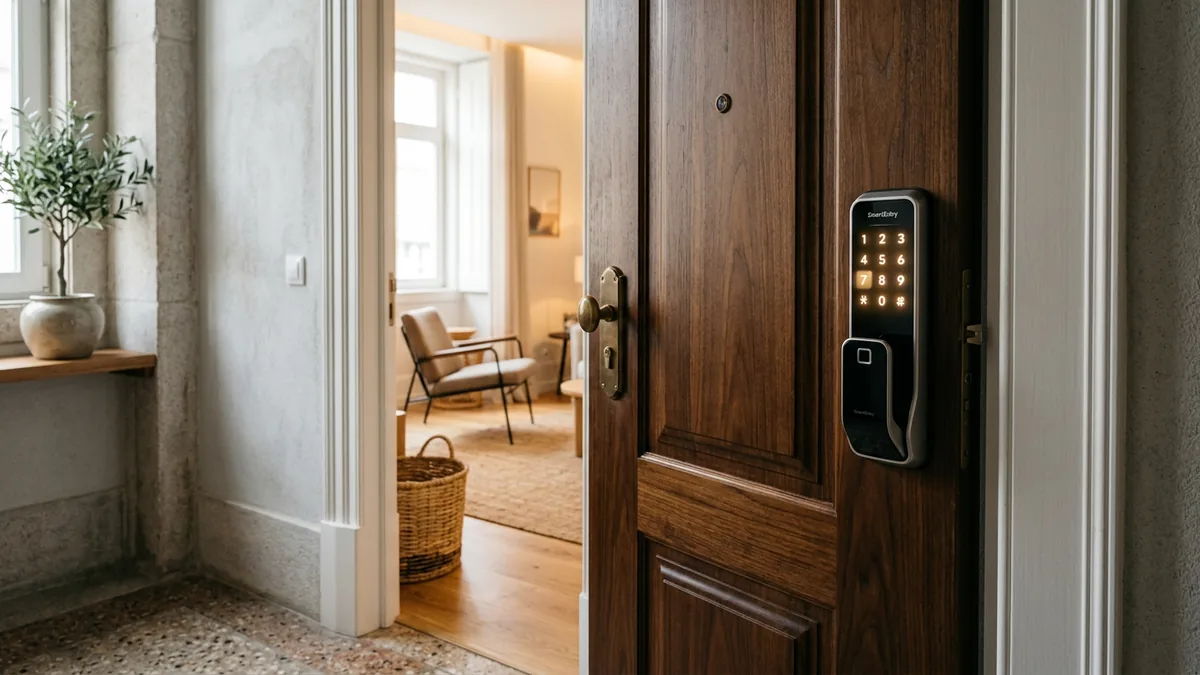
The doubt stops many people before the first reservation even arrives: is it possible to manage an Airbnb remotely without living near the property? The short answer is yes, and thousands of hosts do it every day, operating apartments in cities they never step foot in for months. What separates those who succeed from those who give up is not physical proximity. It is how much of the operation has been transformed into a process.
Managing remotely works when you systematize three areas. Guest entry is solved with self check-in, without you at the front desk. Property turnover is handled by a local cleaning and maintenance team. And guest communication runs on automation that replies on your behalf. Once these three are resolved, location becomes a detail. The property can be a four-hour drive away or in another state, and the operation runs the same.
There is a counterintuitive detail worth anticipating. The area that ties the host to the location the most is not cleaning or maintenance, which you delegate to local people. It is communication, that flow of messages arriving at any time asking for the Wi-Fi password and check-in time. And it is precisely this area, the one that seems to demand the most presence, that is the easiest to automate. This article shows how to build the three pillars of this remote operation.
Key takeaways
- Remote management needs a system: organize entry, local support, and communication before relying on distance operations.
- Entry is solved with self check-in: a smart lock or lockbox lets the guest in via code, without you at the door.
- Property turnover depends on a local team: trusted cleaning and maintenance, with a checklist and post-cleaning photo.
- Communication is what ties you to the location the most and scales best with automation: the same questions, answered automatically.
- Illustrative management budget: 10% to 30% of revenue: automate communication before delegating everything to a management company.
Can you manage an Airbnb living far away?
You can manage an Airbnb remotely when the operation stops depending on you being physically at the property. This is the turning point, and it is more technical than it seems.
Think about what actually requires presence in a vacation rental operation. The guest needs to enter. The house needs to be clean between reservations. Someone needs to answer questions and resolve unforeseen events. And something will break occasionally, requiring maintenance. None of these tasks require that you be there. They all require that someone or something be there, at the right time, with the right process.
Remote management is the work of replacing your presence with systems and local people in each of these areas. When this is set up, living far away ceases to be an obstacle. It just becomes a characteristic of the operation, like the apartment floor or the lock brand.
The areas of remote management are five, but they group into three pillars that support everything:
Beneath the three pillars run two ties that apply to any operation, whether you live nearby or not. The synchronized calendar between Airbnb, Booking.com, and direct bookings prevents double bookings, the kind of error that ruins a review and is expensive to fix remotely. And demand-adjusted pricing ensures the property does not sit empty holding a peak price. Both run on software, so distance changes nothing. What changes in remote operations are the physical pillars, and that is what this guide focuses on.
There is a fifth piece missing, which is neither a pillar nor a tie: the local contingency plan. This is someone trustworthy in the property's city, capable of getting there in an hour when the lock jams or a pipe bursts. It can be the cleaning team itself, a trusted neighbor, or the co-host. Remote operation without this network becomes a gamble. Sooner or later, an unforeseen event arises that no app can solve.
Putting it all together, remote operation has five areas, and each is resolved by something that does not require you at the address:
| Area | What it resolves | Who or what executes |
|---|---|---|
| Entry | guest access | self check-in |
| Turnover | cleaning and restocking | local team |
| Communication | questions and messages | 24/7 automation |
| Calendar and price | double booking and vacancy | management software |
| Unforeseen event | physical emergency | local contingency |
How to resolve guest entry without being there?
Entry is resolved with self check-in, the set of solutions that allows the guest to enter alone, without anyone handing over the key in person. It is the first pillar to build, because in-person key handover is what ties the host to the address the most. Without resolving this, everything else falls apart.
Get the next guides before anyone else
Practical Airbnb management and automation tips, no fluff. One email when new content drops. Unsubscribe anytime.
Self check-in is the process where the guest accesses the property on their own, usually via a numeric code, without an in-person meeting. It transforms the most critical moment of the stay, the arrival, into something that happens without you. There are two main ways to do it, and they serve different host profiles.
The smart lock is the electronic lock that opens via password, app, or card, and allows creating different codes per reservation. It is the most robust solution, with an important caveat: how much of this is automatic depends on the model. Some apply the new password in real time, others only when someone uses the keypad, and native Airbnb lock integration depends on supported models and eligible locations. The cost is installation, battery dependence, and initial setup. How to choose the equipment and test it is covered in electronic locks on Airbnb.
The lockbox is the physical key safe, attached to the door or gate, that stores the key behind a code. It is cheap, does not depend on power or internet, and works on any door. The disadvantage is that the code does not change by itself: you change it manually between guests, which becomes work with high volume. For those starting remotely, it is the safest entry point: it costs little, installs in minutes, and does not let you down if the property's internet drops right when the guest arrives.
The rule of thumb is simple. Start with the lockbox if you are validating the property or operate few units. Upgrade to the smart lock when reservation volume makes manual code changing a bottleneck. Both resolve the entry pillar. They change the effort per reservation, and how much that effort drops depends on the model you buy. To see who passes through the gate, an outdoor camera declared in the listing complements the lock, without filming anything inside the house.
| Solution | Initial cost | Code per reservation | Depends on power |
|---|---|---|---|
| Lockbox (safe) | low | manual | no |
| Smart lock | medium | via app, varies | yes (battery) |
One point practice teaches quickly: self check-in is not just the lock. It is the lock plus clear instructions on how to use it. A perfect code is useless if the guest cannot find the door, does not know the floor, or gets the keypad sequence wrong in the middle of the night. Well-resolved entry combines the device with a message showing a photo of the entrance, the code number, and step-by-step unlocking instructions. This is where the entry pillar touches the communication pillar, and where automation starts making a difference. For details on how to structure these two moments, check the guide on check-in and check-out on Airbnb.
How to build a trusted local team?
Property turnover, that tight interval between one guest's check-out and the next one's arrival, is the second pillar and the one that depends most on people in the city. The local team is the group of local people who take care of the physical part of the property: cleaning, laundry, restocking, and small daily repairs. Without it, remote operation simply does not exist.
In practice, "team" can be a trusted cleaner with 1 or 2 properties, or a specialized company when the portfolio grows. The turning point usually arrives around 4 to 5 properties, or earlier with same-day check-outs, when one person alone cannot handle it. The decision between a cleaner and a company has its own cost, logistics, and scale, and is detailed in whether or not to outsource Airbnb cleaning. What changes in remote operation is that you will not be there to check the result. And that is exactly what the process needs to cover.
The secret to delegating turnover without losing quality control lies in three pieces that replace your eyes on the property:
- Room-by-room checklist. A fixed script of what to clean and check in each room, paying attention to easily missed spots: behind the toilet, inside the shower enclosure, window frames, the back of the air conditioner. Without a checklist, every cleaning depends on the cleaner's mood.
- Post-cleaning photo. The team records critical points (bathroom, kitchen, made bed, spotless linens) before closing the door. This photo is your only eye inside the property when you are miles away. It transforms "I trust it looks good" into "I saw it looks good."
- Maintenance reporting channel. The person cleaning is the one who spots the leak, the burnt-out bulb, the loose lock. A simple channel for the team to notify you (a photo on WhatsApp is enough) makes maintenance happen before it becomes a guest complaint.
Each of these pieces replaces one of your senses that stayed far from the property:
| Control piece | Replaces | Prevents |
|---|---|---|
| Checklist | your cleaning standard | inconsistent cleaning |
| Post-cleaning photo | your visual inspection | surprise complaints |
| Reporting channel | your defect patrol | delayed maintenance |
This arrangement covers both sides of the physical part: cleaning maintains the standard between reservations and maintenance prevents small defects from becoming low ratings. Those who operate from afar learn early that the post-cleaning photo is worth gold. It is the difference between discovering a problem through a message from the team or through a public review from the guest. You resolve the first before the next check-in. The second has already cost you a star.
A reality check is worthwhile from those who have operated properties in another city. The local team is not born ready, and the trust that sustains remote operation is built reservation by reservation, not on the first contract. The first few months require more checking, more photos, more checklist adjustments than you would like. It is annoying, time-consuming, and makes you want to loosen up prematurely. Do not loosen up. Every refined checklist in this phase is a problem that does not become a complaint later, and every photo demanded today is a star you do not lose tomorrow. The agreement is worth writing down: what to clean, what to photograph, how quickly to report a defect. In practice, the detail that separates those who outsource turnover well from those who get burned is the patience of this initial calibration.
As the team repeatedly hits the standard, control naturally yields, and what was tight vigilance becomes a calm routine. Skipping this phase is the most common mistake of those who delegate turnover and disappear the next month, trusting too early. The result usually appears at the worst possible time, in a public review, when it is too late to fix.
How does automated communication sustain remote operations?
Here is the pillar that decides whether remote operation is sustainable or a torment. Guest communication is the flow of messages and questions that arrives before, during, and after the stay, and it is the area that demands the most presence and scales the worst without a system. Resolved with automation, it stops tying you to your phone. Left manual, it turns remote management into a 24-hour on-call shift.
The reason communication is so heavy is repetition. The same questions arrive all the time, from different guests, at impossible hours: what time is check-in, what is the Wi-Fi password, where do I park, is there a market nearby, how does the TV work. If the property is also on Booking.com, this repetition arrives doubled, in two different inboxes. Answering each one manually, in the middle of the night, in another city, is what makes the remote host think they need to live nearby. They do not. They need to get this repetition off their back.
See how the host's time is divided in a vacation rental operation, and why the largest slice is also the most automatable:
The good news hidden in this chart is the inversion of expectation. The task that consumes the most time and seems to demand the most presence, communication, is the one best resolved with software, because it is repetitive and standardizable. Maintenance, which occupies a smaller slice, is the one that most requires local people, because every unforeseen event is different. Those who understand this inversion stop trying to live nearby and start building the right system.
This is where Anfitrione comes in. It automates communication on WhatsApp, answering the guest 24 hours a day. It sends check-in instructions with the code and a photo of the entrance. It answers frequently asked questions, from Wi-Fi and parking to house rules and local recommendations. And it does this in your tone of voice, without you holding your phone. For remote operations, this is what makes the model viable without maintaining a fixed support team. The area that tied you to the location the most starts running on its own, and what is left for you are the decisions that actually move the business. In remote operations, the gain is twofold: the guest receives an instant reply, even in the middle of the night, and you stop waking up to your phone asking for the Wi-Fi password three time zones away.
The difference between in-person and remote operations becomes clear when you separate, task by task, what changes when no one is at the property:
Notice the pattern. Every in-person task has a remote equivalent, and none of them require you at the address. Much of the communication quality lies in the right messages at the right time, from the entry code to the check-out notice. It is worth structuring this script calmly in the guide on messages for Airbnb guests. When communication runs automatically and messages are well written, remote operation stops feeling like juggling and becomes routine. It is also what maintains a high rating, and the relationship between agile communication and 5-star reviews on Airbnb is direct.
How much does it cost and when is it worth having a co-host or management company?
There comes a point when the question stops being "how do I do it alone remotely" and becomes "is it worth paying someone to do it." The answer depends on how much your time is worth and how far away the property is. But the math has concrete numbers that help you decide.
Outsourcing management has a clear cost. A co-host or a management company may charge a percentage of revenue or another agreed fee. Here, 10% to 30% of revenue is an illustrative budgeting range, not a market benchmark. Obtain local quotes for the same service scope. At the low end of the range are leaner arrangements, like a co-host who only handles check-in and the local team. At the high end are full-service management companies, which take over the listing, pricing, communication, cleaning, and finances. See how the range behaves:
The point that most confuses beginners is thinking that the management company's commission replaces the platform's. It does not replace it: it adds up. Airbnb’s service fees depend on the applicable fee structure, and are separate from what your manager charges. Check the actual reservation payout breakdown. The management company's slice comes on top of that. Calculate the total using your actual platform fee, management quote, and the base each percentage applies to. A fee on gross revenue differs from the same percentage on your payout after platform deductions. That is why the decision to delegate everything needs numbers, not exhaustion.
| Arrangement | Who handles what | Typical cost |
|---|---|---|
| You + automation | everything, with automated communication | tools only |
| Co-host | check-in and local team | 10% to 20% |
| Full-service management | listing, price, communication, cleaning | 20% to 30% |
Here is the practical recommendation that closes the reasoning of the post. Before handing the entire operation over to a management company and giving up to 30% of revenue, automate communication. It is the most expensive part to maintain manually and the first thing the management company charges to resolve. With communication running on its own and a trusted local team for turnover, many hosts discover they can manage well remotely without delegating everything, keeping most of the margin. The full-service management company starts making sense when the portfolio grows to the point where coordination, not communication, becomes the bottleneck. To understand when this delegation model becomes a business of its own, it is worth seeing how to be an Airbnb co-host without owning property.
Managing from afar is managing with a system
You can manage an Airbnb remotely. Not with magic, but with three firm legs: entry resolved by self check-in, turnover in the hands of a trusted local team, and communication running automatically. Add synchronized calendar and pricing, a contingency network in the property's city, and distance becomes what it always was beneath the fear: an operational detail, not an impediment.
What ties the host to the location is almost never cleaning or a burst pipe, which you delegate to local people. It is communication, that flow of messages that seems to require you on call. And that is the good news that runs through the entire article: the area that ties you down the most is also the most automatable. When it is off your back, the property can be anywhere.
Operating from afar is not a plan B for those who cannot be close. Well built, it is an operation as solid as an in-person one, with the advantage of not depending on you physically for anything that happens day to day. Start with entry, build the local team calmly, automate communication, and let distance just be geography. If the biggest doubt is still whether the model pays for itself, the honest calculation of income and effort is in can you make a living on Airbnb. For the platform's official overview, the Airbnb help center details rules and resources. And the Airbnb news hub tracks what changes for hosts.
Frequently asked questions
Can you manage an Airbnb living in another city?
Yes, as long as you systematize three areas: guest entry with self check-in, a local cleaning and maintenance team, and automated communication. Thousands of hosts operate properties in markets where they do not even live. What makes this viable is process, not physical proximity.
How does the guest enter the property if I am not there?
With self check-in: a smart lock or a lockbox grants entry via code. You must use a new code per reservation, created by you in the lock app. This way, the guest enters at any time without depending on you being physically present to hand over the key.
How much does it cost to outsource remote Airbnb management?
A co-host or property management company may quote a percentage of revenue or a different fee structure. The 10% to 30% range here is an illustrative budgeting assumption; get local quotes for the actual scope. This is separate from platform fees, which depend on your account, fee structure, and booking. Check your payout breakdown rather than assuming one worldwide rate. Before delegating everything, it is worth automating communication, which is the most expensive part to maintain manually.
What is the hardest part of managing remotely?
Guest communication. It is what demands the most presence and scales the worst without a system, because the same questions arrive all the time: check-in, Wi-Fi, parking. Paradoxically, it is also the most automatable area, since these questions are repetitive and standardizable.
Do I need a smart lock or does a lockbox work?
Both work. The lockbox is cheap and does not depend on power or internet, but the code changes manually. The smart lock lets you create a code per reservation via the app and logs access, at the cost of battery and setup. Start with the lockbox and upgrade to the smart lock when volume justifies it.
Tired of answering the same questions on WhatsApp?
Anfitrione answers your guests around the clock, in your own tone of voice: check-in, Wi-Fi, local recommendations. You get the hours back, and no booking is lost to a slow reply.
Keep reading
30-Day Airbnb Stays: What Changes for Hosts
A one-month booking fills the whole calendar and looks like the deal of the year. What it changes is not the price, but everything you never wrote down before accepting.
Furnishing an Airbnb: 5 Essentials and 3 Bonuses to Wow
Before buying pillows and silverware, secure these 5 essential items for your vacation rental. They show up in reviews and directly influence occupancy.

Airbnb camera rules: where hosts can install them
Airbnb generally bans indoor cameras, even switched off or in shared room-listing spaces. Exterior devices need disclosure; certain licensed properties in Japan have a narrow entryway exception.
Airbnb cleaning checklist: a room-by-room guide
The list that fits the turnover window: seven rooms with clear completion standards, the photos that become proof, and the message housekeeping sends before leaving.
Get new guides by email
Practical Airbnb management and automation tips, no fluff. One email when new content drops. Unsubscribe anytime.