Vacation Rental Amenities That Help You Win Bookings
Which vacation rental amenities to list and offer so you appear in guest search filters, convert more bookings and get more from each unit of money you invest.
By Equipe Anfitrione

Part of the guide: Airbnb algorithm: how it works and how to rank higher
Most hosts treat Airbnb amenities as a checklist: tick what they have, ignore the rest and move on to the photos. The problem shows up before the photos. A guest opens the platform, taps two or three filters, and your listing disappears from the page before anyone sees the view from your bedroom.
Amenities are not decoration. They decide whether you show up in search, and they help separate an ordinary nightly rate from a premium one. Listing the common ones correctly keeps you in the results. Offering the right ones, beyond the basics, can get guests to pay more. And not every amenity pays back the same: some return a lot for each unit of money invested, others mostly drain cash. This guide separates the two, across Airbnb, Booking.com and other channels such as local listing sites and direct bookings.
If your question is what you need inside the home to earn five-star reviews, start with the 5 essentials for setting up an Airbnb. This guide is strategic: what to list and offer so you show up and convert more.
Key takeaways
- Wi-Fi and climate control (air conditioning or heating, depending on your climate) are core amenities: they rarely raise the nightly rate, but missing one can drop you from a filter.
- Pools and hot tubs are among the most searched amenities, and third-party AirROI data associates hot tubs with 34% to 121% higher revenue across four US markets. That is an observational correlation, not a guaranteed gain.
- Accepting pets is linked to roughly 20% more revenue in Nashville in the same observational data, with a relatively modest investment.
- A workspace serves guests who need to work during their stay; assess that segment in your own booking history.
Why do amenities decide search before photos?
Amenities decide search because guests filter by them before looking at any image. An amenity filter is the button a traveler taps to hide every listing that does not offer a specific item. When someone selects "air conditioning" and "Wi-Fi", the platform immediately removes every listing that does not have both boxes checked. Your photos might be the best in town. If the amenity is not listed, they never compete, because the guest never reaches your page.
That changes how you think about the listing. Most hosts focus on the people who see their listing and forget the ones who never get that far. Amenities work at that invisible stage, the filtering stage. That is why listing every real amenity you offer is not a detail: it keeps the property eligible for as many searches as possible. Leaving a common box blank, such as washing machine or parking, means disappearing for a whole slice of guests who filtered for it. Photos sell the click, but amenities earn the appearance. Picture two people searching in the same city, for the same dates and in the same price range. One filters for parking, the other does not. If you have a garage but did not check it, you lose the first guest without ever knowing they existed.
The same logic applies beyond Airbnb. On Booking.com, travelers filter by free Wi-Fi, parking, pets allowed and kitchen facilities in the same way. On local listing sites and direct booking pages, search tends to be simpler, but the rule holds: guests look for what they need and skip what does not fit. Listing on several channels widens your shop window, and the step-by-step is in how to list on Airbnb and Booking.com. On any of them, an unchecked amenity is a booking you never knew you lost.
Which core amenities can you not afford to miss?
Core amenities are the ones guests already expect from any property, so they barely notice them when they are there but leave the listing when they are missing. A core amenity is an item so common it has become a mental prerequisite for travelers: its absence knocks the listing out, its presence does not impress. Wi-Fi and air conditioning are the clearest examples. 2026 market analyses suggest that Wi-Fi, air conditioning, heating and free parking command little or no nightly rate premium in most markets, because guests assume they are included.
Get the next guides before anyone else
Practical Airbnb management and automation tips, no fluff. One email when new content drops. Unsubscribe anytime.
Do not confuse "does not raise the price" with "does not matter". The relationship runs the other way, and it is risky. Wi-Fi is reported to be among the three most-used filters in Airbnb search. Air conditioning can rank as an even higher priority: a 2018 Airbnb-commissioned survey found that 59% of the US travelers surveyed placed it among important indoor amenities. This historical survey is not a current global demand estimate. In other words, these items do not let you charge more, but missing one can knock you out of a filter and out of the booking. They protect your volume, not your margin. Ignoring this is the opposite of the luxury mistake: instead of spending on the wrong item, you save on the item that shows up most in search and pay for it with an empty calendar.
The core list varies by property type, climate and market, so treat it as a starting point rather than a universal rule. Where summers are hot, cooling comes first; where winters are cold, heating matters more. For many vacation rentals, these are the items to have and list before you think about any luxury.
| Core amenity | Why it matters | Cost of missing it |
|---|---|---|
| Fast Wi-Fi | top filter for most guest types | drops you from work-trip searches |
| Air conditioning or heating | key comfort item for your climate | lost bookings in peak heat or cold |
| Equipped kitchen | backbone of longer stays | families and groups move on |
| Parking | common filter outside city centers | invisible to guests arriving by car |
| Washing machine | expected on multi-day stays | loses week-long guests |
In practice, operators find that core amenities work like a car seat belt: nobody praises them, but going without one takes you out of the game. The most common beginner mistake is spending on an eye-catching item while leaving the Wi-Fi unreliable, which is exactly what shows up most in filters.
Which amenities raise the nightly rate, not just volume?
The amenities that raise the nightly rate are destination amenities, the ones guests plan the trip around. A destination amenity is the item that becomes the reason for the booking, not just a comfort detail: people search for a "house with a pool" and pay more for it. The pool is the most searched amenity on Airbnb, and the hot tub sits close to the top. Unlike Wi-Fi, these can command a real price premium, because they create their own demand instead of just meeting a baseline expectation.
The 2026 figures are striking, and worth knowing before you invest. According to AirROI's analysis of amenities that boost revenue, its observational comparisons across Nashville, Scottsdale, the Outer Banks and Gatlinburg found hot-tub revenue differences of 34% to 121%. The pool comparisons in Scottsdale and the Outer Banks showed 50% to 94%. Those are particular US markets, not worldwide return estimates. EV chargers, still rare, can be a differentiator that commands a high nightly rate premium and attracts higher-spending guests, in a filter whose use grew more than 80% between 2022 and 2023. Keep in mind that these are observational correlations from a third-party dataset: properties with these amenities often differ in size, location and positioning as well, so the figures do not prove that the amenity itself caused the extra revenue. These items are expensive to install, but they can move your rate to a different level.
The warning that comes with these numbers is not to copy them onto your situation without adjusting. A hot tub premium in a cold mountain town will not necessarily repeat in a city apartment, and a pool only commands top rates where the heat sustains demand. Read your market before assuming the percentage lands in your pocket. What works in a mountain retreat may sit empty in a downtown high-rise.
Destination amenities are not limited to pools and hot tubs. In family markets, a game room has been reported to support up to 15% higher nightly rates while also lifting five-star reviews. What they all share is that they become the main reason for the booking, and guests accept paying for the experience, not just the bed.
Which amenity earns the most per unit invested?
The amenity that earns the most per unit invested is not always the one with the biggest premium. This is where return per unit spent comes in: how much extra revenue each unit of money spent on an amenity brings back. A hot tub can earn a lot, but it is expensive and slow to pay for itself. Accepting pets earns less in percentage terms, but the upfront cost is very low, so the return per unit spent can be very high. It is the difference between what looks good in the listing and what makes sense in the spreadsheet.
Accepting pets is one relatively low-cost option to evaluate. AirROI’s 2026 Nashville comparison found roughly 20% higher revenue for pet-friendly listings. That association does not prove that accepting pets caused the difference, or establish a worldwide return. Budget for protecting floors, cleaning, and clear pet rules. A Booking.com survey about pet travel reported stronger interest among Brazilian travelers than its global sample; the research was conducted in January 2022, so it is historical context rather than current demand for your destination. Check local demand and competition, and use clear pet fees and rules.
A workspace is another upgrade to assess against your actual guests. A dedicated workspace combines a sturdy desk, a comfortable chair, a nearby outlet and reliable internet. Check the connection where the guest will sit, not just beside the router. Read inquiries and reviews for evidence of work needs before spending. The chart below illustrates how you could classify your own bookings by trip purpose; its 44/56 split is fictional and is not an Airbnb statistic.
This table helps you decide where to put your money first, separating what costs little from what costs a lot. The ratings are qualitative estimates, not guaranteed returns.
| Amenity | Investment | Return per unit spent |
|---|---|---|
| Accepting pets | low | very high |
| Workspace | low | high |
| EV charger | medium | high and growing |
| Pool | high | medium to high |
| Hot tub | high | high, slow payback |
The reality is that the premium ranking and the return-per-unit ranking are different lists, and hosts who confuse them spend in the wrong places. The hot tub leads on premium, but pet-friendly leads on return per unit spent. If you are just starting out, tackle the cheap levers first, pets and a workspace, before dreaming about building a pool.
How do you list amenities to show up on every channel?
Listing amenities correctly matters as much as having them, and rule number one is simple: list everything you actually offer. The platform does not guess. If you have a washing machine but forgot to check the box, a guest who filtered for a washing machine will never see your property, even though it has exactly what they were looking for. Every real amenity left unchecked is an entire search you exclude yourself from without noticing.
Rule number two is the flip side of the first: never list what you do not have. A phantom amenity is the trap that looks clever and ends up costly. A guest filters for air conditioning, finds your listing, books, arrives and discovers there is no air conditioning at all. The result is a bad review, a refund request and, in some cases, a cancellation that can carry consequences for you as a host. Listing what does not exist does not inflate your bookings, it inflates your losses. The filter only works because guests trust it, and breaking that trust comes back to you. Remember that amenities also need to appear in the photos: what is listed and photographed tends to convert much better, and the criteria for good images are in the Airbnb photos that actually get booked.
This care ties directly into ranking. Airbnb's search algorithm is generally understood to favor complete, accurate listings, and well-filled amenities are part of that completeness signal, although no single field guarantees a better position. The mechanics differ a little on each channel, but the principle is the same: fill in everything, honestly, on every platform where you list.
The listing rule fits in a quick yes-or-no table.
| Situation | What to do | Why |
|---|---|---|
| Amenity you have | always check it | you enter more filters |
| Amenity you do not have | never check it | avoids bad reviews |
| Item present but not pictured | photograph and list it | converts much better |
| Same home on another channel | repeat the listing | keeps your shop window full |
| Channel | How amenities appear | Main point of attention |
|---|---|---|
| Airbnb | detailed filters and icons | check every real amenity |
| Booking.com | broad amenity filters | keep it in sync with Airbnb |
| Local listing sites | description and highlights | name each item in the text |
| Direct booking | description and property details | list everything clearly |
How do amenities turn into bookings without swamping your messages?
The right amenities fill the calendar, and then comes the part nobody warns you about: every amenity you list turns into a question. The guest who booked for the pool wants to know its hours. The one who came because of the pet policy asks about the rules. The one looking for a workspace wants to confirm the internet speed. The same amenity that won the booking creates a queue of repeated questions, every day, on every channel.
This is where operations send the bill. Answering the Wi-Fi password, the bed size or whether the barbecue can be used for the umpteenth time eats up the time that should go into improving the listing. Tools like Anfitrione automate this support over WhatsApp: they answer common questions about amenities and send usage instructions and step-by-step check-in details, so you are not tied to your phone. Amenities bring in the booking; automation keeps that success from turning into overload.
What separates the host who scales from the one who stalls is treating amenities as a system, not a list. You choose items by return, list all of them honestly on every channel, photograph what you promised and prepare answers to the questions each amenity generates. When that cycle runs smoothly, filters keep working in your favor without you having to repeat the same information by hand.
Where to start, in short
Amenities are not listing decoration: they decide whether you show up in search and how much you can charge. Start by securing the core ones that fit your market, such as fast Wi-Fi, climate control suited to your local weather, a kitchen, parking and a washing machine, because they protect your volume even when they do not raise the price. Then go after the cheap, high-return levers, accepting pets and setting up a workspace, which open whole audiences for little money. Leave expensive projects like a pool or a hot tub for when the numbers work and your market calls for them. List everything that is real, on every channel, and never anything that is not. Filters favor listings that are complete and honest, and they work against hosts who leave boxes blank or promise what they do not have. The right amenity is not the most expensive one. It is the one your guests are searching for and you actually deliver.
Frequently asked questions
Which amenities do the most for Airbnb bookings?
The ones guests use as search filters do the most for booking volume: Wi-Fi, climate control suited to your market (cooling where it is hot, heating where it is cold), an equipped kitchen, parking and a washing machine. Listing every common amenity you actually have keeps you in the results. To raise the nightly rate, destination amenities such as a pool or a workspace tend to carry more weight, though results vary by market and are never guaranteed.
Do Wi-Fi and air conditioning raise the nightly rate?
Rarely by much. Wi-Fi and air conditioning are core items guests already expect, so in most markets they do not command a price premium. But missing one can remove you from a filter and cut your booking volume. They protect bookings rather than lift the nightly rate. Where winters are cold, heating plays the same role.
Is it worth accepting pets in a vacation rental?
Often, yes. Accepting pets is a relatively low investment that opens your listing to guests who filter for it. In Brazil, a Booking.com survey found that Brazilian travelers value pet-friendly stays more than the global average, so check pet demand in your own market. The return per unit spent can be high, as long as you adjust your house rules and cleaning fee.
Do I need to list every amenity I have?
Yes, list every one that actually exists. Search filters only show your property if the amenity is checked, even if you have it. Leaving one blank means disappearing from an entire search. Never list something you do not have: a phantom amenity turns into bad reviews and cancellations.
Does a workspace really help bookings?
It helps in markets with work travelers and digital nomads. Business guests filter for a dedicated workspace and fast Wi-Fi, and this segment has grown considerably on Airbnb. A sturdy desk, a good chair and stable internet are enough to position the listing for that filter at low cost.
Tired of answering the same questions on WhatsApp?
Anfitrione answers your guests around the clock, in your own tone of voice: check-in, Wi-Fi, local recommendations. You get the hours back, and no booking is lost to a slow reply.
Keep reading

Airbnb algorithm: how it works and how to rank higher
Understand the Airbnb search funnel, the factors hosts can improve, and the limits of what anyone can infer about an unpublished ranking system.
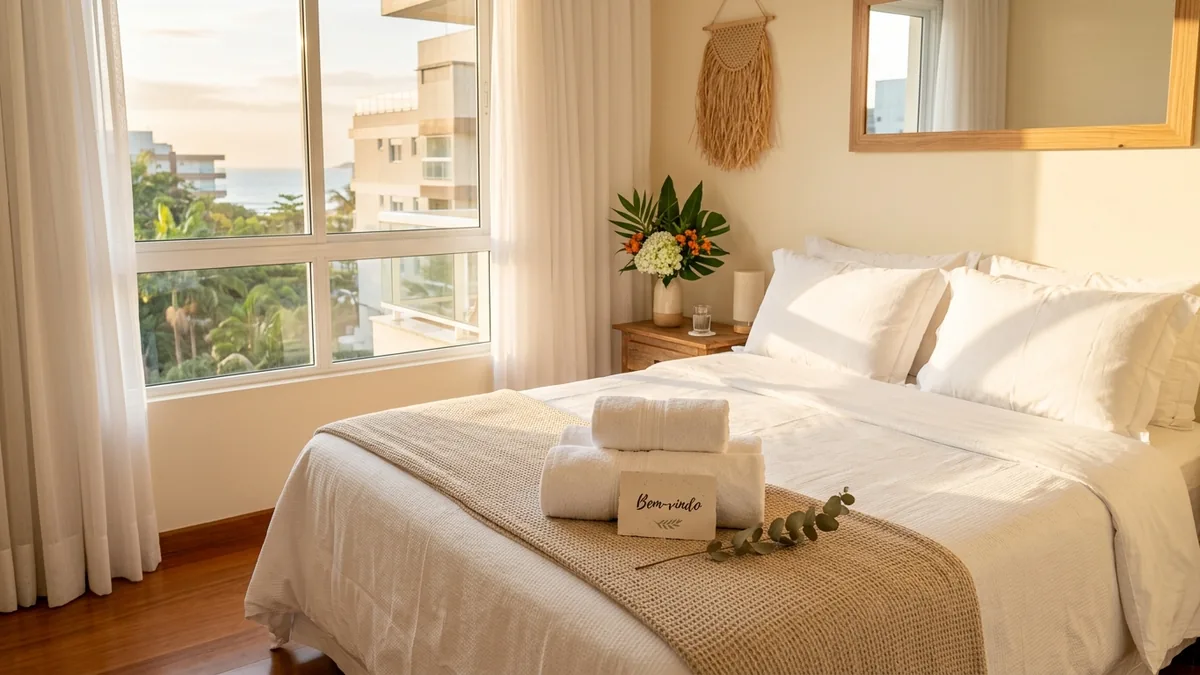
Airbnb Guest Favorite: how to earn the badge
Superhost is a test with a published passing score. Guest favorite is a daily comparison with other listings, which is why a 5.0 rating can still miss out.
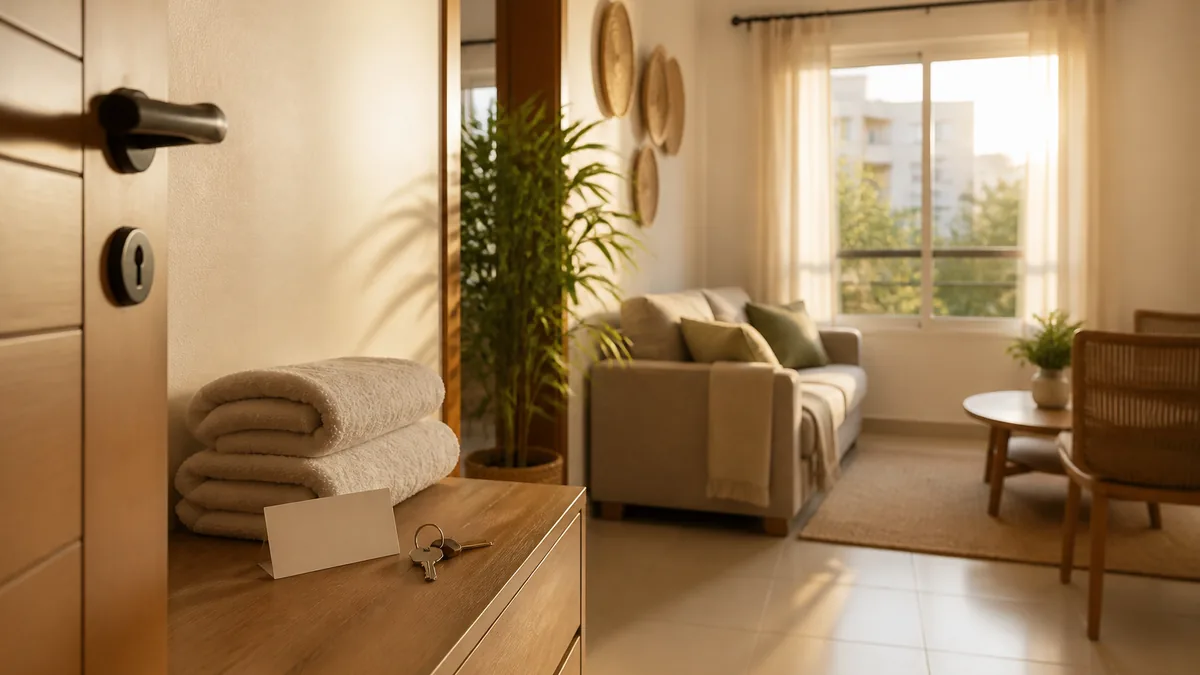
Airbnb Instant Book: should you turn it on?
Hosts often treat the toggle as a question of trusting guests. In practice it is an operations call: it depends on whether guests can get in on their own.

Airbnb Low Season: How to Fill Your Calendar
When tourists leave, your calendar does not have to empty out. Discover tactics to attract a new audience and fill the low season without slashing rates.
Get new guides by email
Practical Airbnb management and automation tips, no fluff. One email when new content drops. Unsubscribe anytime.