Airbnb algorithm: how it works and how to rank higher
How the Airbnb algorithm works: understand search factors, diagnose your listing funnel, and separate response-rate rules from unsupported ranking claims.
By Equipe Anfitrione

The Airbnb algorithm orders personalized search results using many factors. Airbnb identifies quality, popularity, price and location as important; it does not publish the complete model or each factor’s weight. Search results vary with the trip, available inventory, and the guest, so there is no single fixed position to defend. Ranking higher is not about luck or hidden tricks. It is about giving the platform clear signals that you convert. The good news is that these signals are known and under your control. The bad news is that most hosts focus on a few and ignore the rest, especially response time. This guide shows how the algorithm really works, which levers move the ranking, and which one almost every host leaves on the table, using a practical diagnostic model and published platform guidance.
Main points
- Our diagnostic funnel has 3 stages: appear, consider, and convert. It helps organize a performance review; it is not the published algorithm architecture.
- 5 visibility levers: open calendar, instant book, price, reviews, and popularity.
- Response rate and response time differ: Airbnb measures the former for Superhost, while faster replies can help guests decide.
How does the Airbnb algorithm really work?
The official guide on how search results work identifies quality, popularity, price and location among the important factors. The funnel below is our diagnostic model, not a published description of internal algorithm stages.
The Airbnb algorithm orders listings for each search. Its full objective, architecture and weights are not public. For an operating review, it is useful to separate three questions: did the listing appear, did the traveler consider it, and did a booking follow? That is an editorial diagnostic funnel. It does not establish that Airbnb runs three corresponding internal stages or always maximizes a single booking-probability score.
It is worth dismantling a myth before moving on. There is no single clever trick that ranks a listing. As the platform's own team admits, you cannot just throw it out there and expect the algorithm to do the magic. You play along by delivering the right signals at each stage of the funnel, and the position comes as a consequence.
Another point that confuses many people is that search is personalized. Each guest sees a different ranking, built from the profile of the person searching. Searching for your own property in the app does not show the real position, because your usage profile is not that of the guest you want to attract. The reality is simple. Stop hunting for your position and take care of the signals that move the funnel. One important exception is that this search does not measure position, but measures existence. If you cannot even find yourself on the region's map, the problem is no longer ranking but visibility, which has its own causes and can be solved in minutes. This case is covered in what to do when the listing does not appear in search.
| Common myth | What the algorithm does |
|---|---|
| There is a secret trick | Rewards those who close bookings |
| Searching shows my position | The showcase is personalized |
| Lowest price always wins | Weighs conversion and reviews |
The three stages become the roadmap for the rest of this guide. First you need to appear. Then you need to be clicked. Finally, you need to convert. Each section below takes care of one of them.
What makes your listing appear in Airbnb search?
Get the next guides before anyone else
Practical Airbnb management and automation tips, no fluff. One email when new content drops. Unsubscribe anytime.
For the visibility step of our diagnostic model, review five practical areas: calendar availability, instant book, competitive price, listing quality, and popularity. They work together, and none alone guarantees the top spot.
- Calendar availability: open as many months ahead as possible and make the minimum stay flexible. More genuinely available dates let you match more searches. Airbnb does not publish a universal visibility multiplier for a given percentage of open nights.
- Instant book: instant book is the option that lets the guest close on the spot, without waiting for your approval. It wins filtered searches and usually increases conversion because, as the platform itself says, people do not like to wait.
- Competitive price: compare genuinely similar properties and your full guest-facing price. There is no universal rule to price 10% or 20% below competitors; protect your cost floor and test demand.
- Listing quality: the Guest Favorite badge goes to the most highly rated and reliable listings. At a host event, Airbnb team members stated it has more relevance than Superhost because it qualifies the listing, not the person. Airbnb does not publish this weight. It is recalculated every day, comparing the listing with others globally and nationally, in tiers (Top 10%, 5%, and 1%), and looks at the rating, subcategories, and even review text. The criteria and why a 5-star rating might be left out are in the Guest Favorite guide. Being well-decorated with the right amenities helps, and it is worth checking the essential items to set up the property.
- Popularity: a listing that is seen, clicked, and booked becomes a rare find and the algorithm promotes it. The goal is to attract the right audience, not everyone.
Keep availability accurate wherever you advertise. Calendar conflicts and avoidable cancellations harm the operation. Airbnb does not publish a general exclusivity bonus, so do not assume listing on another platform lowers your search placement.
| Lever | What to do | Signal to the algorithm |
|---|---|---|
| Calendar | Open months ahead | Has dates to sell |
| Instant book | Activate | Closes without friction |
| Price | Close to competition | Converts on click |
| Quality | Reviews and amenities | Delivers good experience |
| Popularity | Attract right audience | Already proves it books |
Why appearing is not enough to get the booking
After appearing, the listing needs to be clicked and booked. If it appears but generates little interest, or visits do not become bookings, investigate the offer. That pattern alone does not prove how Airbnb changed the ranking. Three things rule here: photos, clear pricing, and marked amenities.
The photo is the number one lever for the click. A listing with professional photos and good home staging conveys the property in seconds, while a crooked photo scares people away before they even read the description. The cover photo carries this weight almost alone, because it is what appears in the results grid. The step-by-step on how to photograph the listing to rent more shows the lighting, order, and mistakes that decide this click.
Marking all amenities also counts, because they act as search filters. If you have Wi-Fi, air conditioning, and a washing machine but did not mark them, your entire listing disappears when the guest filters for these items, even if they appear in the photo. Each filter is a cut. In a beach search, turning on beachfront can drop results from over a thousand to about 550, and gym from 51 to 25. An incomplete listing does not lose position, it loses the entire search. A visible discount, with the old price crossed out, helps the click and pushes the decision of those still comparing options.
Reviews are an important quality signal in Airbnb’s published search guidance. The platform does not publish weights that would establish them as universally the strongest factor. New positive reviews can change your displayed average; the effect depends on your existing ratings and review count. Airbnb does not publish a precise recency weight or ranking recovery speed. The detail that separates those who rise from those who stall is treating each stay as a source of review, not as a task ended at check-out.
| Stage | What you control | Diagnostic metric |
|---|---|---|
| Appear | Calendar and price | Search impressions |
| Consider | Photos and cover | Click-through rate |
| Convert | Reviews and response | Completed bookings |
This is the loop that many people ignore. Visibility without bookings does not sustain revenue. Diagnose the offer rather than assuming the pattern reveals an internal ranking penalty. Attracting the right audience is worth more than attracting a crowd.
Why response time is the forgotten lever
Responding promptly helps guests decide. Response rate, rather than a universal one-hour response target, is the documented measure affecting Superhost and search placement. The response rate is the percentage of new messages you respond to within 24 hours, and it appears on your profile for the guest to see.
The official requirement is clear. To become a Superhost, Airbnb requires a 90% response rate over 365 days, according to the Airbnb help center on response rate and time. The requirements to become a Superhost confirm the 24-hour response window. Airbnb does not publish a universal 16% impressions uplift, a guaranteed conversion increase, or a generally available one-hour badge in the cited guidance.
Superhost, by the way, comes down today to four numbers measured over the previous 12 months and reviewed every quarter, and the overall rating is the first of them. It is worth seeing how the rating feeds the ranking to understand why a full rating pulls visibility, not just the badge. Airbnb can recalibrate these thresholds, so always check the help center:
| Superhost criteria | Threshold (Oct/2026) |
|---|---|
| Overall rating | 4.8 or higher |
| Response rate | at least 90% within 24h |
| Cancellation | under 1% |
| Completed bookings | 10 (or 3 totaling 100 nights) |
Now comes the practical part for hosts. Guests often move conversations to messaging apps like WhatsApp, and the same ten questions arrive all the time: check-in, Wi-Fi, parking, house rules. Every minute without an answer is a guest comparing another listing, and the biggest gap is outside business hours, when you are sleeping or at work. Those who operate realize that the first message is conversion, not support.
| Response metric | What Airbnb asks |
|---|---|
| Response rate | 90% over 365 days for Superhost |
| Response time | Separate indicator, no universal one-hour requirement |
| Window that loses most | outside business hours |
This is exactly where automation helps. Tools like Anfitrione answer repetitive guest questions on WhatsApp, send check-in instructions, and local recommendations 24 hours a day, without you needing to have your phone in hand. The official Airbnb response rate is measured in the platform's inbox, so the gain here is not moving that direct number. The gain is the discipline of never leaving a guest waiting, which is the same muscle that search and Superhost reward.
How long until the algorithm reacts?
Airbnb does not publish a standard deadline for search changes to settle. Use several weeks of comparable demand to judge changes rather than expecting an overnight result. A two-to-eight-week observation window is an operating choice, not an official recalibration period.
In the meantime, measure the right signal. The listing conversion rate is the fraction of those who see and click that end up booking. Beware of a measurement trap. The Conversion tab in the Airbnb dashboard divides bookings by search views, not by clicks, so the number that appears on the screen is usually well below 1% and does not compare with the references in this section. They are two different denominators with the same name, and how to read the view conversion rate in the dashboard breaks down both. Track the sequence of views, clicks, and bookings over the weeks, adjust one lever at a time, and compare. Consistency over time beats a single tweak, and calibrated expectations prevent panic decisions. If the goal is predictable income, it is also worth understanding what to expect in income before betting all your chips.
The 3 steps of the funnel and where to act on each
Before tweaking the price in a panic, think of the funnel in three steps. They translate "few bookings" into a diagnostic hypothesis. Your problem is appearing, being clicked, or closing. It is a reasoning map, not a screen reading. The dashboard delivers the ends, search impressions and bookings, which gives the aggregate conversion and only that. Separating the two middle steps would require a number of clicks that the dashboard does not isolate, so this part is solved by indirect evidence. Tweak one lever at a time, for four weeks, and see if the aggregate responds.
| Funnel step | What it measures | If it is low, tweak |
|---|---|---|
| 1st page impression | how many searches you appear in | calendar, instant book, price |
| Search to click conversion | how many click when seeing the grid | cover photo, title, price |
| Click to booking conversion | how many close after entering | photos, amenities, reviews |
A good step does not sustain the other, which is why the same symptom has opposite causes. Appearing a lot and converting little points to good positioning with a weak offer. Appearing little and converting well points to the opposite, a good offer that the algorithm still shows little. Which of the two is your case does not come ready from the dashboard. It comes from tweaking the showcase and seeing if the aggregate moves. As reading thresholds, when you have the number of clicks through another route, a click-through rate above 5% is strong and a click-to-booking conversion above 4% is excellent, while below 2% usually indicates a problem on the listing page. These are our thresholds, based on the click denominator, and not averages published by Airbnb.
Two listings, the same "few bookings", opposite causes
Two hosts complain of "few bookings" and the problem is the opposite of each other. Just looking at the funnel step by step shows which way to run. Compare two listings from the same operation, in the same period, with illustrative numbers and based on the click denominator, not on the number the dashboard prints.
| Funnel step | Listing A | Listing B |
|---|---|---|
| 1st page impression | ~80% | ~35% |
| Conversion to click | ~2% | ~9% |
| Conversion to booking | ~5% | ~6% |
Listing A appears a lot and the page converts well for those who enter, but almost no one clicks. The bottleneck is in the showcase, meaning the cover photo, title, and price that do not pull the click, and that is where a title and description that sell make a difference. Listing B is the reverse. When it appears, it pulls a lot of clicks and closes well, but the algorithm barely shows it. It lacks appearing, which is solved by activating instant book and adjusting the calendar and price for the system to print more. The similar final conversion hides opposite causes, and each listing requires the opposite adjustment. The rule of thumb is to tweak one lever at a time and measure over two to eight weeks, as a practical observation window, not an official algorithm timetable.
Play along, not against
In the end, mastering the Airbnb algorithm is less about tricks and more about coherence. You improve the offer and use the funnel to investigate where demand is being lost, without claiming certainty about search placement. You appear with calendar and price, get clicked with good photos, and close with reviews and quick responses. No single lever works miracles, and consistency over the weeks is what sustains the position. The natural next step is to tie all this into a routine, and the complete host guide helps set up this operation without becoming a hostage to your phone.
Frequently asked questions
How does the Airbnb algorithm work?
Airbnb ranks personalized results using many factors, including listing quality, popularity, price and location. Availability and booking settings affect which searches a listing can match. The three-stage funnel in this guide is our diagnostic model for impressions, clicks and bookings, not a published description of the algorithm.
How to rank higher in Airbnb searches?
To appear more, open your calendar several months in advance, turn on instant book, keep your price close to the competition, gather good reviews, and respond quickly. Each of these signals tells the algorithm your listing has a high chance of turning into a booking.
Does response time affect Airbnb ranking?
Airbnb distinguishes response rate from response time. Response rate can affect search placement and Superhost eligibility; Superhost requires at least 90% within 24 hours over the past 12 months. Replying quickly helps guests, but no official percentage gain for replying within an hour is published.
Does instant book affect my listing's search position?
Indirectly. Airbnb states it has a positive effect on response rate, and that rate can improve placement. The direct gain is the instant book search filter. The platform does not publish a percentage increase in bookings. To decide whether to turn it on, see our dedicated guide.
How long does it take for a listing to rank higher after optimizing?
Airbnb does not publish a standard ranking recalibration deadline. Track performance over several weeks, changing one thing at a time and considering seasonality and demand. A two-to-eight-week review period can be a useful operating choice; it is not a platform promise.
Tired of answering the same questions on WhatsApp?
Anfitrione answers your guests around the clock, in your own tone of voice: check-in, Wi-Fi, local recommendations. You get the hours back, and no booking is lost to a slow reply.
Keep reading
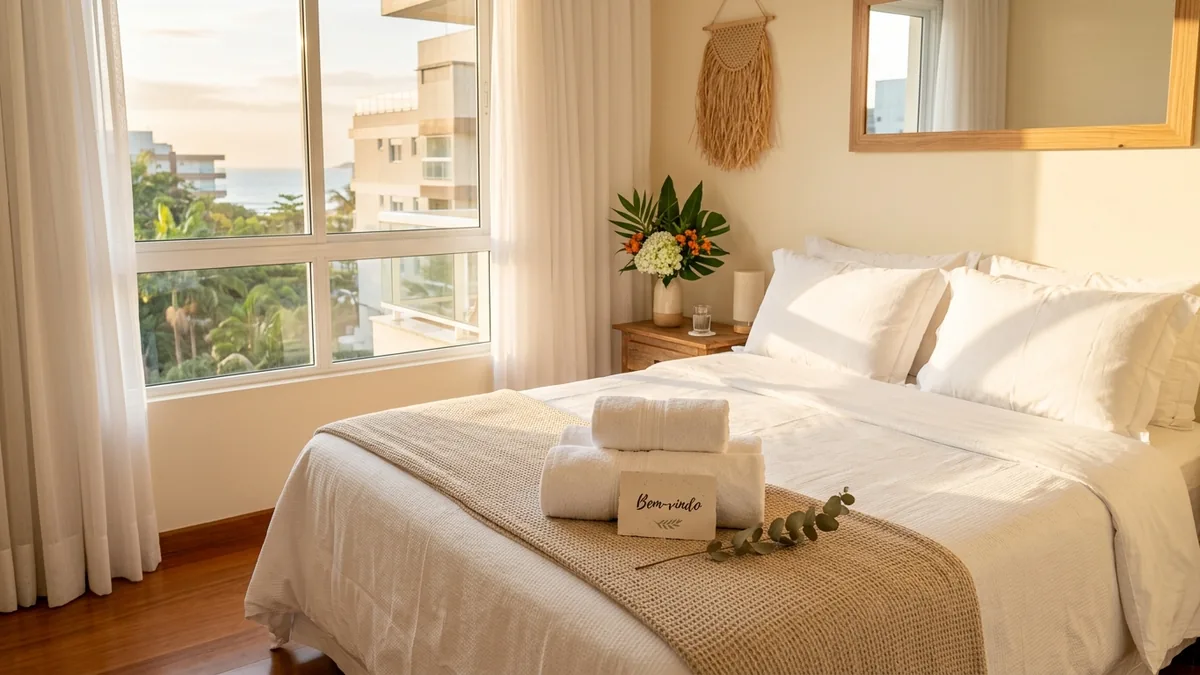
Airbnb Guest Favorite: how to earn the badge
Superhost is a test with a published passing score. Guest favorite is a daily comparison with other listings, which is why a 5.0 rating can still miss out.
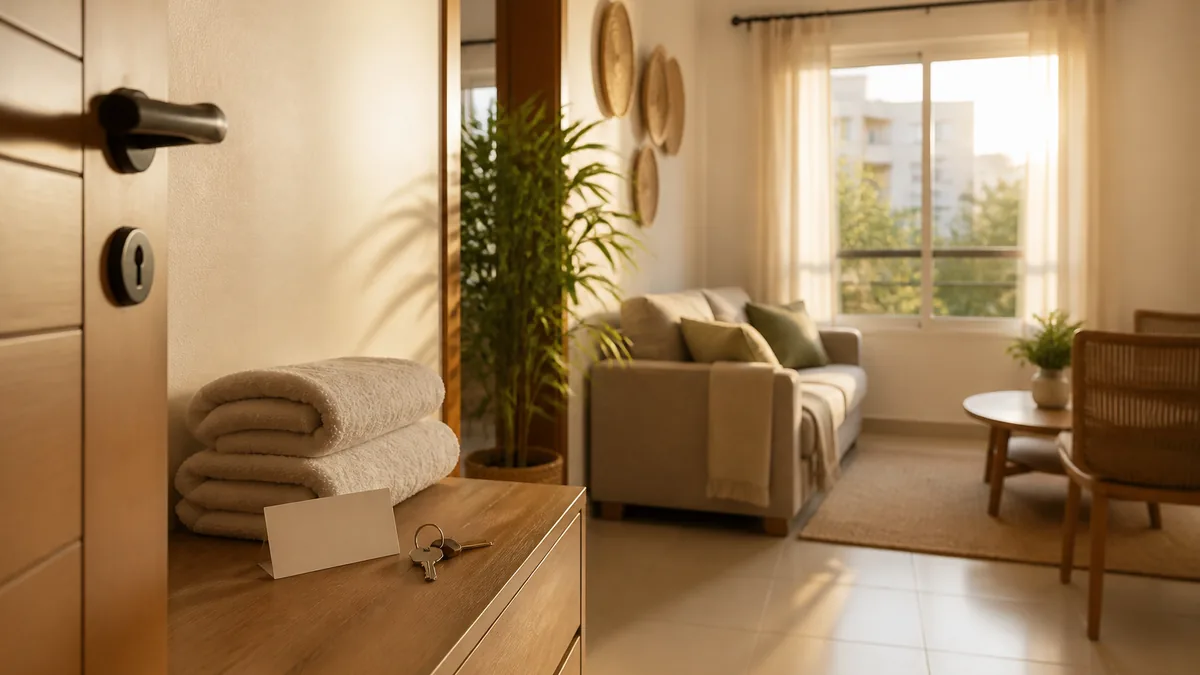
Airbnb Instant Book: should you turn it on?
Hosts often treat the toggle as a question of trusting guests. In practice it is an operations call: it depends on whether guests can get in on their own.

Airbnb Low Season: How to Fill Your Calendar
When tourists leave, your calendar does not have to empty out. Discover tactics to attract a new audience and fill the low season without slashing rates.

Airbnb Photos That Sell: How to Shoot Your Listing
The cover photo decides whether a guest clicks or scrolls past. Here is how to build a photo set that sells your place without a studio or an expensive camera.
Get new guides by email
Practical Airbnb management and automation tips, no fluff. One email when new content drops. Unsubscribe anytime.