Airbnb welcome basket: what to include and how to restock
Build an Airbnb welcome basket with useful items, a clear cost per booking and a simple restocking routine. Includes two welcome card templates for guests.
By Equipe Anfitrione
Part of the guide: 5-star Airbnb reviews: how to get and maintain them
An Airbnb welcome basket is an optional arrival gift. You can offer a welcoming card on its own, a packaged product or a small local keepsake. Choose something you can restock at every turnover, after making sure the home is clean, the beds are ready and access is straightforward.
This guide offers three possible selections, two welcome card templates and a way to calculate the full cost per booking. You can adapt the process to Airbnb, Booking.com and direct reservations. Platform-specific rules are identified where they apply.
Key takeaways
- Cover the basics first: gifts are optional; an item promised in the listing must be provided or an alternative solution agreed.
- Choose a repeatable selection: a card, a sealed product or a local keepsake, without assuming preferences.
- Calculate per booking: count products, time and restocking. A basket costing 10 still costs 10 during a longer stay.
What should you put in an Airbnb welcome basket?
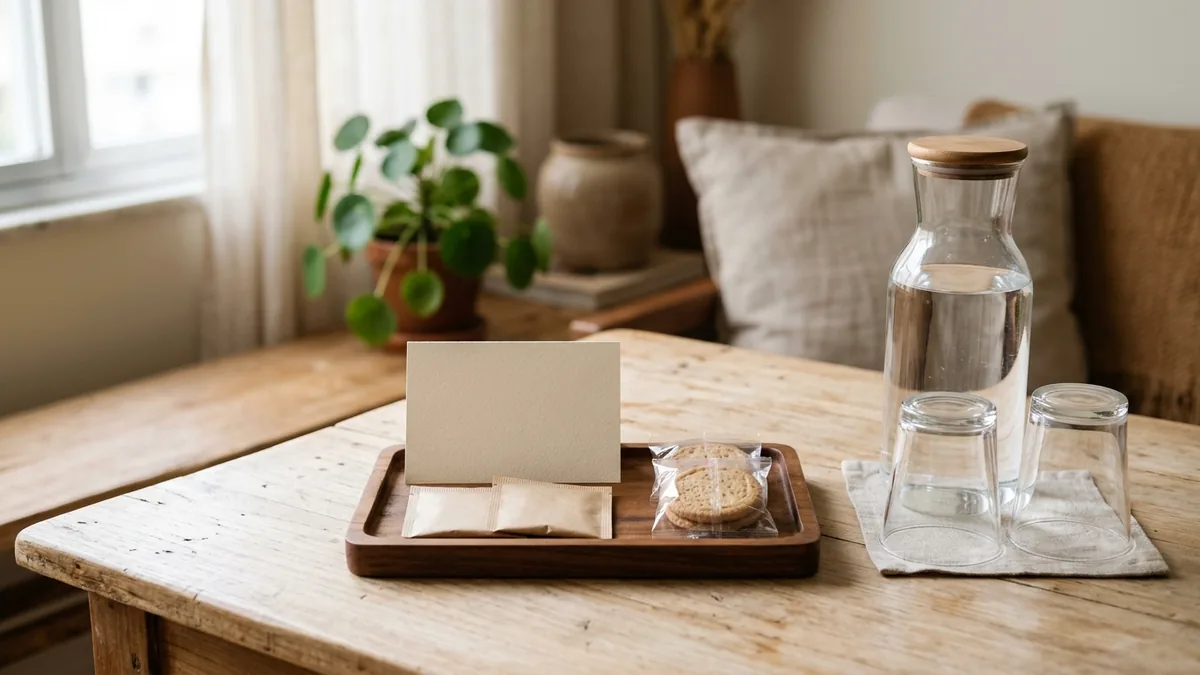
Choose a small welcome: an arrival card, a card with a sealed product, or a card with a local non-food keepsake. A welcome basket is an optional selection prepared to greet guests on arrival. It does not replace the home's essential supplies.
A card on its own can offer a welcome and practical guidance. A short message, the location of the house manual and a contact channel help someone who has just arrived. If you want to add a gift, consider tea or biscuits in their original packaging, or a postcard by a local artist that the guest can take home. These are possibilities, not a required shopping list. Your choice depends on storage, restocking and what suits the property. Toilet paper, soap, towels and bed linen have a different role: Airbnb includes them among the basics in its guidance on preparing your space. Presenting necessities as gifts creates confusion. Make the home ready to use first; then decide whether an extra improves arrival without burdening the routine.
| Selection | What to check |
|---|---|
| Arrival card | Correct name, guide and contact |
| Card + sealed product | Label, storage and replacement |
| Card + local keepsake | Make clear it is theirs to keep |
A gift to take home and a decorative object should be easy to tell apart. If the postcard is a gift, say so. If the mug stays in the property, do not put it in packaging that makes it look like a present.
How do you choose items without creating extra work?
Choose items your team can check, store and replace without improvising. A product only you can buy from a distant shop creates a dependency. A simple selection with a planned alternative makes turnovers easier to organize.
Think about the actual arrival. Can guests use what you leave? Does the coffee work with the available machine? Can the packaging be opened without a special tool? Is there a clean, visible place for the tray? A gift that needs instructions may be less convenient than a well-written card.
For food, keep original packaging, readable ingredients, expiry information and appropriate storage. Do not describe a selection as safe for everyone. The Food Standards Agency's allergy guidance helps explain why product information matters. It does not make UK requirements universal rules for your property. If you cannot establish that an option meets a known need, choose a non-food gesture or just the card.
Get the next guides before anyone else
Practical Airbnb management and automation tips, no fluff. One email when new content drops. Unsubscribe anytime.
Alcohol, strong fragrances and homemade products need not be part of the standard selection. The more you rely on unknown preferences or special preparation, the harder the welcome becomes to repeat. You can also host thoughtfully without buying an object for every stay.
Before photographing the basket for your listing, ask whether you can supply that selection consistently. Repeated pictures of an overflowing basket can create expectations your restocking budget cannot sustain. Describe precisely what is included.
How much does a welcome basket cost per booking?
The full cost goes beyond the price of the products. Cost per booking means the total assigned to one stay, including materials, purchasing, delivery, assembly and applicable waste. Use that figure to decide whether the gift fits your operation.
To calculate a basket's cost, add the products and packaging used to the share of shopping and delivery costs serving that booking. If one purchase supplies several baskets, divide its cost between them; do not charge the whole delivery to every guest. Include time spent assembling, checking and placing items in the property, even when you do that work yourself. Choose a consistent way to value that time. Record losses from expired, broken or discarded products when they occur. A whole pack's purchase price is not necessarily the cost of the portion used. That difference matters when you buy in bulk but use only part of the stock. Calculating per booking lets you compare options without relying on the impression that an item costs almost nothing.
In a purely illustrative example, the basket costs a total of 10 in whichever currency you use. This simulation assumes zero waste. In real operations, add losses when they occur. These figures are neither market prices nor a recommended budget.
| Component | Illustrative amount |
|---|---|
| Products used | 6 |
| Packaging | 1 |
| Allocated shopping and delivery | 1 |
| Assembly time | 2 |
| Total per booking | 10 |
A one-night booking absorbs the 10 in that night. Across five nights, the allocation is 2 per night; across ten, it is 1. The basket still costs 10 per booking. The calculation spreads the same expense across more nights without making the purchase cheaper.
Guest welcome cards: two templates to copy
Use a short card with the correct name, one useful direction and a working contact channel. Adapt the placeholders and check the text before printing.
With a gift:
Hello, [name]! Welcome to [property name]. We have left [item] as a complimentary welcome gift. The house manual, including Wi-Fi and appliance instructions, is at [location]. If you need help, contact us through your booking channel. Enjoy your stay! [signature]
Without a gift:
Hello, [name]! We are glad to welcome you to [property name]. The house manual is at [location], with Wi-Fi details and information about using the space. If you need anything, contact us through your booking channel. We hope you enjoy your stay. [signature]
A welcome card should greet guests and point them toward help without attempting to reproduce the entire house manual. A confirmed name and a practical direction are enough to personalize the text. Do not infer the purpose of the trip, relationships between guests or preferences from a profile photo. If there is a gift, identify what guests can consume or take away. When there is no gift, the card still works without explaining its absence. Choose a visible position and readable lettering; a digital access code can complement the information but need not be the only way to find basic guidance. Airbnb recommends leaving an accessible printed manual in its guidance on welcoming your first guests. The contact sentence should name a channel you or your team actually monitor.
Put complete instructions in the house manual. For booking confirmation and messages throughout the stay, use these guest message templates. The physical card handles arrival without taking over the role of those materials.
Who restocks the basket between bookings?
Assign responsibility for restocking and a final check before releasing the property, even if one person performs both roles. Choose quantities per booking or per guest and record the standard.
You might provide one card per booking. A consumable product might have a quantity per guest, if that is your chosen selection. Without a written rule, the same team may prepare different quantities at each turnover. A reference photo without guest information helps show placement and amounts.
| Stage | Assigned responsibility |
|---|---|
| Plan arrivals | Check quantities needed |
| Assemble and restock | Follow selection and quantities |
| Release the property | Check labels, condition and card |
| Purchase again | Use consumption and lead time |
A reorder point is the stock level you choose for starting a new purchase before supplies run out. Consider arrivals expected before the next delivery and a buffer suitable for your operation. There is no single quantity for every property.
Plan for an unavailable item too. If the gift is optional, unadvertised and not specifically promised to the guest, you can use the card alone. If the listing or confirmation promised that item, notify the guest before arrival and propose a solution. Confirm agreement. If the guest declines, follow the booking channel's applicable resolution procedure.
Does a welcome basket help you get better reviews?
A basket alone does not justify promising a higher rating. The experience includes what was advertised, cleanliness, rest and problem resolution. On Airbnb, the Reviews Policy prohibits incentives and pressure intended to influence reviews. The gift must be unconditional, with no connection to posting a review or choosing stars.
To decide whether to keep the basket, record what you can observe without inventing causation. Consumption shows use, not everyone's satisfaction. An unsolicited comment shows that person's opinion, not a return on the amount spent.
| Observation | Decision to consider |
|---|---|
| Items repeatedly left over | Reduce quantities or change selection |
| Restocking delays turnover | Simplify the basket |
| Costs grow unchecked | Review purchasing, time and waste |
For the wider guest experience, explore the guide to five-star Airbnb reviews. A gift cannot make up for an unfulfilled promise.
An arrival routine you can maintain
In practice, the best standard is one your team can carry out during an ordinary turnover with available information and supplies. Test a small selection, check its full cost and adjust restocking based on what happens in your property.
The detail that matters after the gift is how easily guests can ask for help. Where WhatsApp use is permitted and chosen by the guest, tools such as Anfitrione answer routine questions using property information. Keep decisions and records required by a platform in the appropriate channel.
A well-written card can be enough. If you add a gift, choose one you can sustain when the week gets busy too.
Frequently asked questions
Do I have to provide an Airbnb welcome basket?
An arrival gift is optional; essential supplies and amenities promised in your listing serve a different purpose. You can welcome guests with a short card and a home ready to use. If a basket or specific product is advertised as part of the stay, provide it or agree a solution with the guest if unavailable.
How much should I spend on a welcome basket?
Set your budget using the full cost per booking and the margin your operation can support. Include products, packaging, shopping, delivery, assembly time and waste. Allocate shared purchasing costs across the baskets supplied. There is no universal budget: a small, consistent gesture may suit your operation better than an elaborate basket that is difficult to maintain.
Should I leave wine for every guest?
Do not treat wine as a default for every booking. Some guests do not drink alcohol, and local restrictions or needs may be unknown to you. Choose a simple alcohol-free option or a card without a gift. Keep product information available for any food or drink, and follow its storage requirements.
Can I offer a gift in exchange for a five-star review?
On Airbnb, no. Its Reviews Policy prohibits incentives and pressure intended to influence reviews. A welcome gift must be unconditional, with no connection to posting a review or choosing a rating. The card can welcome guests and explain where to ask for help; it should not present the gift as a reward for positive feedback.
Does every guest need a different welcome basket?
You do not need to personalize everything. Choose a standard selection and quantities per booking or guest. Adapt it only when you know a need and can meet it consistently. A correct name and useful information already make the card personal. Avoid guessing preferences or dietary needs from a profile photo.
Tired of answering the same questions on WhatsApp?
Anfitrione answers your guests around the clock, in your own tone of voice: check-in, Wi-Fi, local recommendations. You get the hours back, and no booking is lost to a slow reply.
Keep reading

Airbnb trip change request: what to check before accepting
An available night is only part of the decision. Check the new group, price and turnaround; declining the request keeps the original reservation in place.

Airbnb pre-approval: when to send it and what to check
Pre-approving an inquiry does not hold the dates for that guest. Identify the difference between an inquiry, a request and a confirmed booking before acting.

5-star Airbnb reviews: how to get and maintain them
A perfect rating is not won by arguing over a bad review later. It is built beforehand: an honest listing, fast replies, and frictionless check-in.

Airbnb cancellation policy: which one to choose
Your cancellation policy is a dial that trades bookings for protection. Here are Airbnb's four standard options and how to pick one that guards revenue without scaring guests away.
Get new guides by email
Practical Airbnb management and automation tips, no fluff. One email when new content drops. Unsubscribe anytime.